lunes, 9 de marzo de 2015

Minister Silva to lead Peru delegation at Panama’s Expocomer 2015


  • portada
    Photo: Cortesía
12:55.
 Lima, Mar. 07.
 Peru’s Minister of Foreign Trade and Tourism (Mincetur), Magali Silva, will head to Panama city to lead the Peruvian delegation at Expocomer 2015 Panama Trade Fair taking place from March 11th to 14th.

Silva will leave for Panama on March 10 and return Peru on the 22nd.

Housing, Construction and Sanitation Minister, Milton Von Hesse, will take over the Foreign Trade and Tourism portfolio, while Silva is absent.

The government official’s trip was approved by the Presidency of the Peruvian Council of Ministers through Supreme Resolution No 060-2015-PCM, published today in the official gazette El Peruano.

Expocomer Business Center receives trade missions from Africa, America, Asia, the Caribbean and Europe interested in exploring commercial opportunities. 

More than 100 Peruvian businessmen will attend the fair to represent 60 companies in the clothing, food, manufacture, service and tourism industries.   

While in Panama, Silva will also hold a meeting with Jorge R. Arosemena, President of City of Knowledge Foundation

jueves, 5 de marzo de 2015

Nearly 200 Mochica culture art pieces showcased in Barcelona


Almost 200 art pieces from ancient Mochica from valleys in northern Peru have crossed the ocean to the Mediterranean coast, in order to take part in an exhibit introduced today at the CaixaForum Museum in Barcelona, according to AFP news agency.

Many times outshined by the Inca Empire that would take shape a few centuries later, the Mochica Culture –that flourished around 200 A.D. in the Moche River valley– will restore its position through this display due to open on Friday under the name "Arte mochica del antiguo Perú. Oro, mitos y rituales"  (Mochica Art from Ancient Peru: Gold, Myths and Rituals).

Pottery vessels, jewels, ceremonial objects made of precious metal, textiles and liturgical objects in wood, stone, shells and bone have been placed in the said museum “to feature ancient artists’ dexterity,” stated CaixaForum.

The exhibition will run through June 7 and will later move to Madrid's CaixaForum.

The pre-Colombian art works were taken from Lima's Larco Museum.

CaixaForum stressed the civilization was already present in the region long time before the development of the Incas, together with Cupisnique and Chimu cultures.

Cusco: Environmental interpreters to promote tourism in protected areas


  • portada
    Photo: ANDINA/Difusión 
12:41.
 Cusco, Mar. 05.
 Cusco city was the meeting point for more than 200 tourism professionals and tour guides offering tour services at Manu National Park, who took part in a workshop for environmental interpreters.

Organized by the National Service of Natural Areas Protected by the State (Sernanp), the meeting was aimed at consolidating nature tourism development in protected natural areas of Peru as one of the strategies that best supports its conservation.

Sernanp informed that visits to Manu National Park increased by 43.95% compared to 2013 and 2014, which has contributed to the economic and social development of the most remote communities in this part of the country.

The first day of the workshop was devoted to key tourist aspects that tour guides and tourism professionals must know such as tourism management, protocols, regulations, protection of isolated indigenous communities and initial contact.   

Another aspect taken into consideration had to do with the importance of providing visitors with quality services and up-to-date information. 

This first part of the workshop allowed access to recent research studies on representative fauna carried out at Manu.

Talks were given by Sernanp experts and forest rangers from Manu and Bahuaja Sonene national parks.

During the second day, experts explained the importance and progress made in sustainable tourism in protected natural areas. 

They also presented studies on biodiversity and emblematic species of the park.

Cusco: Environmental interpreters to promote tourism in protected areas


  • portada
    Photo: ANDINA/Difusión 
12:41.
 Cusco, Mar. 05.
 Cusco city was the meeting point for more than 200 tourism professionals and tour guides offering tour services at Manu National Park, who took part in a workshop for environmental interpreters.

Organized by the National Service of Natural Areas Protected by the State (Sernanp), the meeting was aimed at consolidating nature tourism development in protected natural areas of Peru as one of the strategies that best supports its conservation.

Sernanp informed that visits to Manu National Park increased by 43.95% compared to 2013 and 2014, which has contributed to the economic and social development of the most remote communities in this part of the country.

The first day of the workshop was devoted to key tourist aspects that tour guides and tourism professionals must know such as tourism management, protocols, regulations, protection of isolated indigenous communities and initial contact.   

Another aspect taken into consideration had to do with the importance of providing visitors with quality services and up-to-date information. 

This first part of the workshop allowed access to recent research studies on representative fauna carried out at Manu.

Talks were given by Sernanp experts and forest rangers from Manu and Bahuaja Sonene national parks.

During the second day, experts explained the importance and progress made in sustainable tourism in protected natural areas. 

They also presented studies on biodiversity and emblematic species of the park.

Peru named best cultural and culinary destination in South America August 11, 2014

Peru grabbed some top prizes at the World Travel Awards 2014.

Peru named best cultural and culinary destination in South America
(Photo: Zachary Bennett/Peru this Week)
According to El Comercio, Perú walked away from the World Travel Awards 2014 South America in Quito, Ecuador with three new trophies: best culinary destination, best cultural destination, and leading heritage destination.Peru is once again winning international awards as a travel destination due to the many diverse sites and experiences offered to tourists.
In addition to country-wide honors, a number of Peruvian businesses were awarded prizes. The JW Marriott Hotel in Lima was named South America’s Leading Hotel and Leading New Hotel. Delfines Hotel and Casino in Lima was named South America’s Leading Casino Resort, and Belmond Miraflores Park was named South America’s Leading City Hotel.
Lima was awarded the “Leading City Break Destination” prize. Quito, the host city, was named South America’s Leading Destination.
El Comercio reports that Elizabeth Astete, Peruvian ambassador in Quito, was present at the ceremony to receive the awards.

domingo, 1 de marzo de 2015

Peru to participate in ITP Berlin Travel Trade Show


  • portada
    Photo: ANDINA/Percy Hurtado Santillán
11:40.
 Lima, Feb. 28.
 Peru Export and Tourism Promotion Board (Promperu), together with national tourist companies, will take part in the ITB Berlin (Internationale Tourismus-Börse Berlin) to be held from March 4 to 8 in Berlin, Germany.

As a Leading Travel Trade Show, ITB Berlin is one of the foremost business platforms for global touristic offers and brings together, among others, tourism associations, representatives from the press and media, and tourism professionals. 

In this sense, Peru’s participation in the show is important, as it is a great opportunity for PromPeru to position the country as a multi-thematic destination for cultural, nature and adventure tourism.

In addition, this will be a chance to the further develop the country’s tourist attractions and strengthen working ties with the main tour operators in Germany.

This closeness will allow PromPeru to provide updates on new destinations and current infrastructure, as well as the exclusive services the country has to offer.

The event will trigger joint actions to help improve business between Peruvian and German operators.

Beyond Machu Picchu — Choquequirao, Lost City in the Clouds

The first rays of morning sunlight illuminate the great stone altar, streaming through a square opening over my head. “Inti camac sumac,” chants the priest. Soaked in sweat, I fight the bindings holding me to the stone as the grinning, looming, scarlet-cloaked figure slowly brings down a gleaming, bloodstained bronze knife toward my heaving chest.
Choquequirao - Ziegler“Jefe, buenos dias — café?”
Startled suddenly awake, I thankfully greet a smiling Pancho, our camp cook, handing a cup of wake-up coffee through the tent door. Whew — I make a silent oath to myself to avoid the second round of piscos that we had passed around the campfire last night.
We are on our way back to the mysterious and magnificent mountain Inca city in the remote cloud-forested Andes of Peru that has been the focus of my research and explorations for many years and numerous expeditions.
I am traveling with an interesting group of ethno-botanists. Our objective is to identify plants and trees that may have been introduced by the Inca residents and may still live on in the tangled vegetation surrounding the recently cleared stone walls and buildings.
There is always something more to learn at the Inca’s second Machu Picchu.
Choquequirao arrow
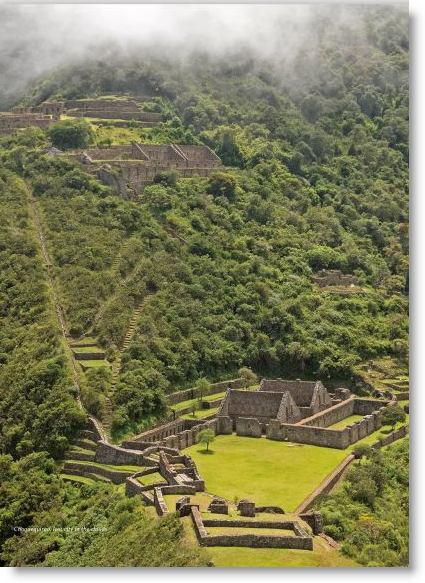
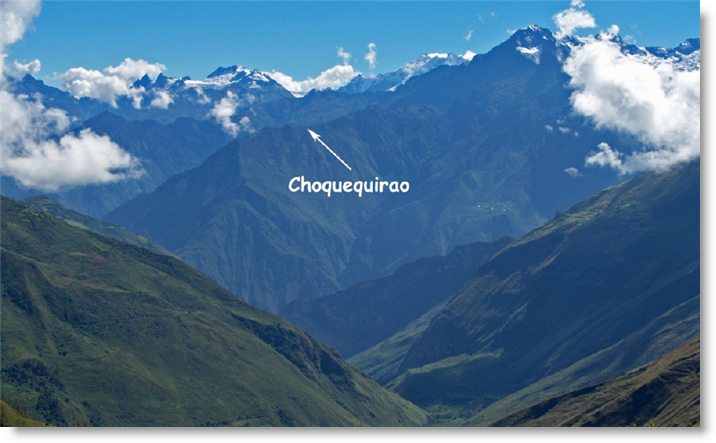
The Inca royal estate and ceremonial complex, Choquequirao is perched majestically at 9,800 feet of elevation on the cloud-forested ridge of a glaciated 17,700 foot peak.
The traditionally sacred Apurimac River, reportedly the longest headwater source of the Amazon, roars through a deep canyon some 5000 feet below. The site lies 61 miles west of Cusco in the rugged, remote Vilcabamba range of the Peruvian Andes, far distant from roads, trains and the tourist hordes that mob Choquequirao’s famous sister estate, Machu Picchu.
Choquequirao remains one of the great, rewarding travel destinations of the Americas that still retain some of the excitement and discovery experience of the past.
It is a truly ‘lost city,’ abandoned sometime around 1572 when the holdout last Inca ruler, Tupac Amaru was captured in the distant jungles, dragged back to Cusco and executed by Spanish colonial authorities. The ancient houses, temples, canals and walls were soon reclaimed by the silent, green, primeval forest only to be rediscovered and revealed in recent times. Located on the far, unpopulated and geographically hostile side of the immense Apurimac Canyon, the region remained disconnected from the farms, villages and roads of developing Peru.
It is little known that Yale professor Hiram Bingham, the now famous scientific discoverer of Machu Picchu in 1911 was inspired to launch his return to Peru and archaeological explorations after a visit to Choquequirao in 1909. Bingham visited Choquequirao twice, the second time with a crew of surveyors, cartographers and specialists to produce the first map and scientific description.