domingo, 1 de marzo de 2015

Beyond Machu Picchu — Choquequirao, Lost City in the Clouds

The first rays of morning sunlight illuminate the great stone altar, streaming through a square opening over my head. “Inti camac sumac,” chants the priest. Soaked in sweat, I fight the bindings holding me to the stone as the grinning, looming, scarlet-cloaked figure slowly brings down a gleaming, bloodstained bronze knife toward my heaving chest.
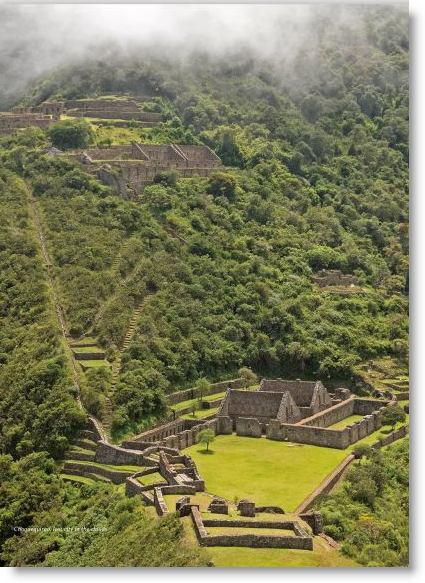
Choquequirao - Ziegler“Jefe, buenos dias — café?”
Startled suddenly awake, I thankfully greet a smiling Pancho, our camp cook, handing a cup of wake-up coffee through the tent door. Whew — I make a silent oath to myself to avoid the second round of piscos that we had passed around the campfire last night.
We are on our way back to the mysterious and magnificent mountain Inca city in the remote cloud-forested Andes of Peru that has been the focus of my research and explorations for many years and numerous expeditions.
I am traveling with an interesting group of ethno-botanists. Our objective is to identify plants and trees that may have been introduced by the Inca residents and may still live on in the tangled vegetation surrounding the recently cleared stone walls and buildings.
There is always something more to learn at the Inca’s second Machu Picchu.
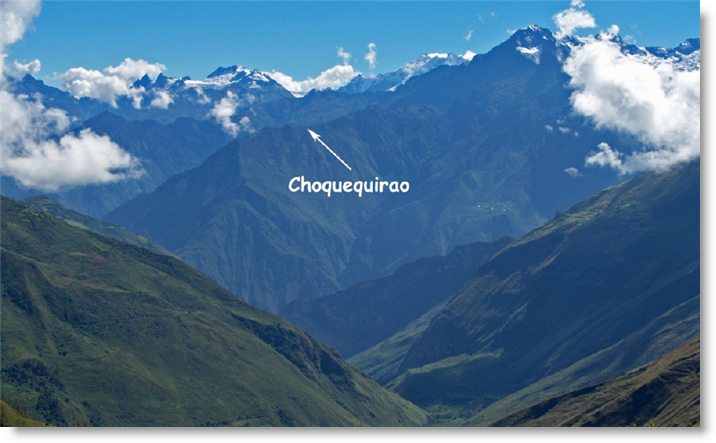
Choquequirao arrow
The Inca royal estate and ceremonial complex, Choquequirao is perched majestically at 9,800 feet of elevation on the cloud-forested ridge of a glaciated 17,700 foot peak.
The traditionally sacred Apurimac River, reportedly the longest headwater source of the Amazon, roars through a deep canyon some 5000 feet below. The site lies 61 miles west of Cusco in the rugged, remote Vilcabamba range of the Peruvian Andes, far distant from roads, trains and the tourist hordes that mob Choquequirao’s famous sister estate, Machu Picchu.
Choquequirao remains one of the great, rewarding travel destinations of the Americas that still retain some of the excitement and discovery experience of the past.
It is a truly ‘lost city,’ abandoned sometime around 1572 when the holdout last Inca ruler, Tupac Amaru was captured in the distant jungles, dragged back to Cusco and executed by Spanish colonial authorities. The ancient houses, temples, canals and walls were soon reclaimed by the silent, green, primeval forest only to be rediscovered and revealed in recent times. Located on the far, unpopulated and geographically hostile side of the immense Apurimac Canyon, the region remained disconnected from the farms, villages and roads of developing Peru.
It is little known that Yale professor Hiram Bingham, the now famous scientific discoverer of Machu Picchu in 1911 was inspired to launch his return to Peru and archaeological explorations after a visit to Choquequirao in 1909. Bingham visited Choquequirao twice, the second time with a crew of surveyors, cartographers and specialists to produce the first map and scientific description.

miércoles, 25 de febrero de 2015

Vía de acceso a Machu Picchu está interrumpida

Crecida de río ha ocasionado el colapso de un puente carrozable en la zona de Aobamba.

Vía de acceso a Machu Picchu está interrumpida
25 de Febrero del 2015 - 10:34 | Cusco -
Las constantes precipitaciones pluviales han originado el desborde del río Aobamba en Santa Teresa (Cusco), lugar que sirve de paso alterno para los turistas que desean llegar a Machu Picchu.
Es así que un puente carrozable que servía de paso para los visitantes extranjeros y nacionales colapsó generando que decenas de turistas se queden varados.
Las autoridades locales ya se comunicaron con sus pares del Instituto de Defensa Civil y de la Dirección de Cultura Cusco para las acciones correspondientes.

jueves, 31 de marzo de 2011

LARES TREKKING


This trek is for those who want to get out off the beaten track but still want to see Machupicchu. Lares takes you to a place so hidden that very few people have gone there. The Lares trail is known for its crystal-clear lakes and stunning mountain chains, high Andean Glaciers, its network of valleys and its indigenous Incan people who live amongst these mountains.

You will really get an in-site into the authentic communities and see thatched stone houses surrounded by herds of llamas and alpacas, and even guinea pigs running loose inside the houses.

In the town of Lares itself you can enjoy the thermal springs, a unique place to learn about traditions and a new way of life.

It begins from a small village in the Sacred Valley and ascends over two major passes (over 4,000 meters / 13,234 feet).

CUSCO PERU (ABROAD TREKKERS)


The Cusco Peru Inca Trail is therefore a memorable destination, full of history and culture, a City with a splendid legacy and an obligatory destination for all who travel to our country. The Cusco Peru is also the departure point for visiting the impressive Inca Citadel of Machupicchu.

With over 6 years experience Abroad Trekkers is a young and dynamic company. Abroad Trekkers was created by a team whose aim is to provide a true level of satisfaction.

Abroad Trekkers specialize in Adventure and Cultural Trekking and tours in and around Cusco Peru.

Cusco Peru is situated in the region know as the Vilcabamba. This area extends between the Apurimac and Urubamba rivers where the 45km Inca trail lies within.

INCA TRAIL (4DAYSINCATRAIL.COM)

In addition to being the trailhead for the Inca Trails , Km 88 is also the site of the ruins of Qoriwayrachina which are located near the Urubamba River. Most hikers do not enter Qoriwayrachina to explore it. However, there are unique stone sculptures and alters present at Qoriwayrachina, making it well worth the effort to explore.

The next archaeological site encountered on the Inca trail are the ruins of Llactapata, a site that is thought to have been used primarily used for crop production. Llactapata is very well preserved and is located at 9,318 feet (2,840 m) above sea level. Its name means "High Town" in Quechua.

The Llactapata Ruins on the Classic Inca Trails should not be confused with the ruins of the same name located west of Machu Picchu that are observable on the alternate Inca Trail trek. Recent studies of the Llactapata Ruins located on the trail indicate that the settlement was positioned, designed and functioned as a sacred center similar to the Inca Trails, while the Llactapata Ruins on the Classic Inca Trail were more agricultural. Sadly, few trekkers leave the Classic Inca Trail to visit the ruins that are located far below the trail. Peru cusco

Tags

viernes, 25 de marzo de 2011

SALKANTAY TREKKING

The alternate Salkantay trek begins near the village of Mollepata at 9,515 feet (2900 meters). Usually, outfitters use pack horses to help carry food and equipment in order to lessen the burden on trekkers. During the first day, hikers enjoy magnificent vistas of "Apu Salkantay Trekking" and the lush Apurimac River Valley below. The trail passes through Andean communities like Cruzpata, Challacancha, and Soraypampa where the first campsite is usually located. After the first day, trekkers will encounter very few locals on their journey to Machu Picchu. The second day begins with a three hour ascent to the Apacheta Pass at 15,060 feet (4,590 meters). From the pass, hikers can see three mountains, Salkantay Trekking, Humantay, and Huayanay. After a five hour downhill hikes, trekkers arrive at Rayan-Niyoc or Chaullay to camp for the night.

Tags

sábado, 19 de marzo de 2011

INCA TRAIL (4DAYSINCATRAIL.COM)

In addition to being the trailhead for the Inca Trails , Km 88 is also the site of the ruins of Qoriwayrachina which are located near the Urubamba River. Most hikers do not enter Qoriwayrachina to explore it. However, there are unique stone sculptures and alters present at Qoriwayrachina, making it well worth the effort to explore.

The next archaeological site encountered on the Inca trail are the ruins of Llactapata, a site that is thought to have been used primarily used for crop production. Llactapata is very well preserved and is located at 9,318 feet (2,840 m) above sea level. Its name means "High Town" in Quechua.

The Llactapata Ruins on the Classic Inca Trails should not be confused with the ruins of the same name located west of Machu Picchu that are observable on the alternate Inca Trail trek. Recent studies of the Llactapata Ruins located on the trail indicate that the settlement was positioned, designed and functioned as a sacred center similar to the Inca Trails, while the Llactapata Ruins on the Classic Inca Trail were more agricultural. Sadly, few trekkers leave the Classic Inca Trail to visit the ruins that are located far below the trail. Peru cusco

Tags